





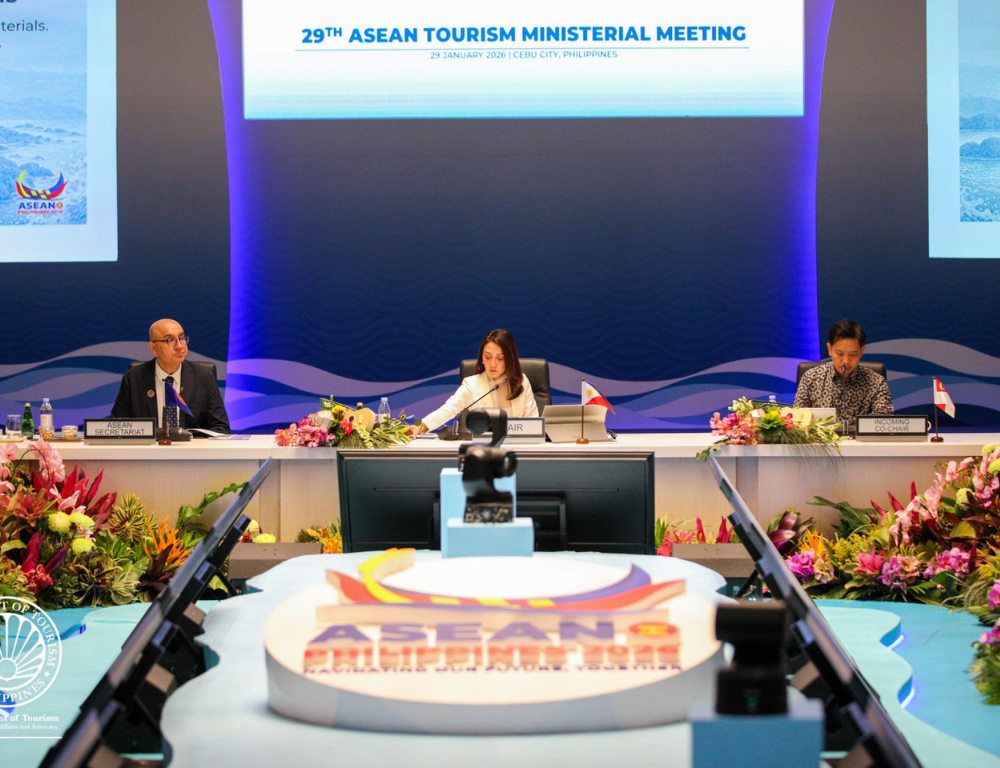
The Philippines has emerged as one of the Association of Southeast Asian Nations’ (ASEAN) strongest tourism economies, ranking among the region’s top contributors in economic impact and employment generation, according to the latest report presented during the ASEAN Tourism Ministers’ Meeting on Thursday (Jan. 29) in Cebu.
Based on the 2025 World Travel and Tourism Council (WTTC) Economic Impact Report, the Philippines ranked first in terms of tourism GDP valued at USD 91.8 billion–the highest in ASEAN–surpassing other major regional tourism economies such as Indonesia(US$71.7 billion), Thailand (US$67.3 billion), and Singapore (US$54.6 billion). Tourism accounts for 19.9 percent of the Philippine economy, placing the country among the most tourism-significant economies in Southeast Asia, both in scale and impact.
In terms of employment, the Philippines likewise ranks among ASEAN’s top tourism job generators, with tourism supporting approximately 11.22 million jobs nationwide. This represents 23.0 percent of total national employment, one of the highest shares in the region, exceeded only by Cambodia. In absolute terms, the Philippines has the second-largest tourism workforce in ASEAN, next only to Indonesia, underscoring tourism’s role as a major source of livelihoods for Filipinos.
These figures highlight the Philippines’ unique position in the region—combining high economic value with strong employment intensity. While some ASEAN economies show high tourism dependence with smaller overall scale, the Philippines stands out for delivering both scale and inclusivity, reinforcing tourism’s role as a people-centered growth engine.
Department of Tourism (DOT) Secretary Christina Garcia Frasco said the data affirm tourism’s critical contribution to national development under the Marcos Administration.
“These figures clearly show that the Philippines ranks among ASEAN’s leading tourism economies. With tourism contributing nearly US$92 billion to our economy and supporting over 11 million Filipino jobs according to the WTTC, tourism remains a powerful driver of inclusive growth, job creation, and economic resilience for our country,” Secretary Frasco said.
She added that the Philippines’ strong performance reflects the DOT’s continued focus on strengthening the tourism value chain, empowering the workforce, and ensuring that tourism growth translates into tangible benefits for communities nationwide.
As ASEAN Chair for 2026, the Philippines reaffirmed its commitment to advancing regional cooperation that strengthens tourism’s contribution to economic growth, expands quality employment, and positions Southeast Asia as a resilient and competitive tourism region.
-30-