




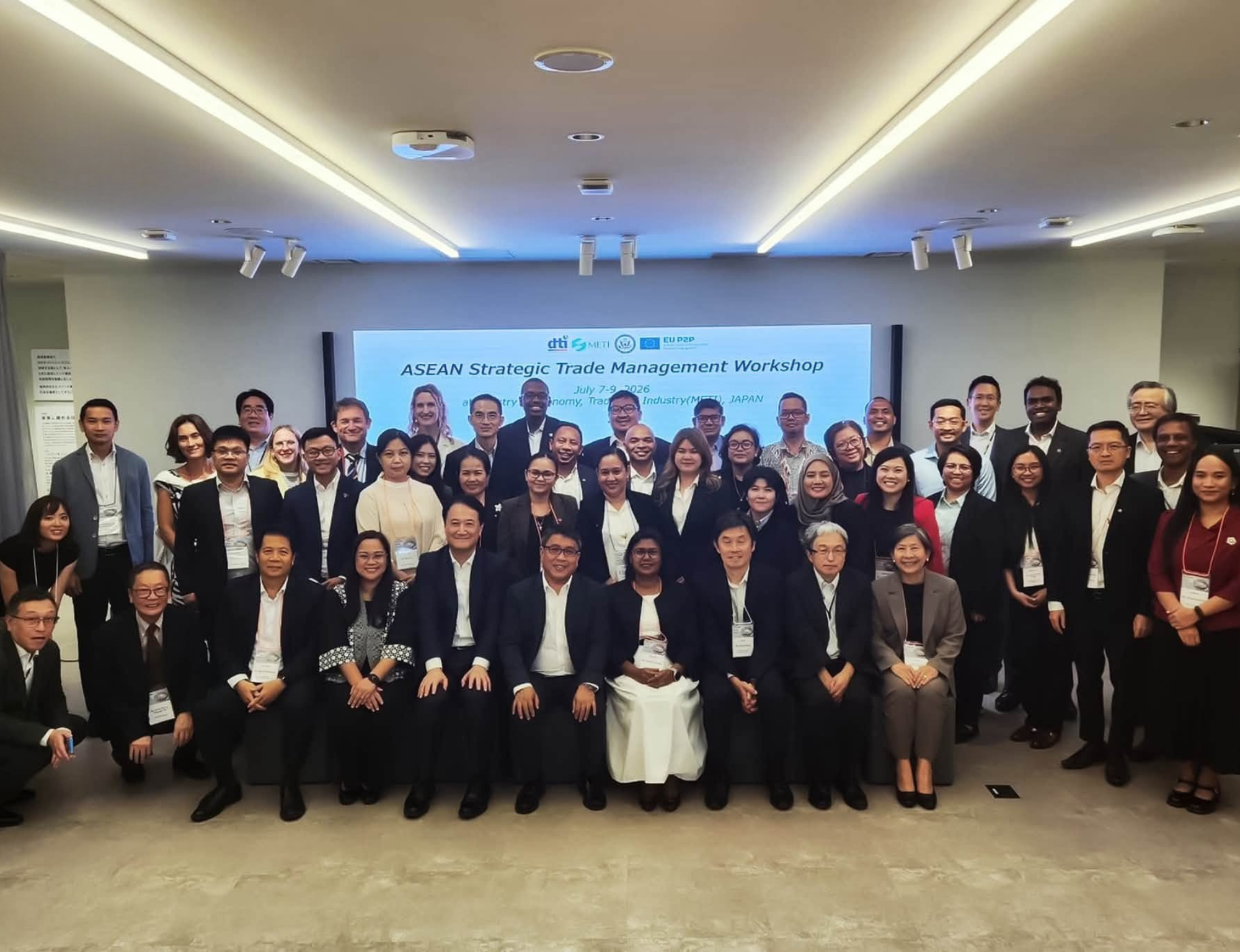
The Philippines, through the Department of Trade and Industry – Strategic Trade Management Office (DTI-STMO), together with Japan’s Ministry of Economy, Trade and Industry (METI), co-hosted the Second ASEAN Capacity Building Workshop on Strategic Trade Management (STM) from on 07-09 July 2026 in Tokyo, Japan.
The workshop was supported by the United States Export Control and Border Security Program, European Union Partner-to-Partner Export Control Programme and the Center for Trade Excellence.
The workshop forms part of the Philippines’ 2026 ASEAN Chairship Priority Economic Deliverable and supports the proposed ASEAN Leaders’ Declaration on Strategic Trade Management for Secure Regional Trade. It also builds on the inaugural ASEAN STM Capacity Building Workshop held in Boracay, Philippines in December 2025.
The regional workshop brought together ASEAN Senior Economic Officials, STM Officials and international partners to strengthen regional cooperation on STM and promote a common understanding of measures that facilitate secure and responsible trade.
Discussions focused on how effective STM systems contribute to economic security, resilient supply chains, responsible investment, and trusted trade while preventing the diversion of strategic goods, advanced technologies, and software for unauthorized purposes.
Participants exchanged national experiences on developing legal and institutional frameworks, licensing systems, enforcement mechanisms, and industry engagement. A private sector panel highlighted the importance of transparent, predictable, and practical regulatory frameworks that support legitimate trade while ensuring effective compliance.
Interactive breakout sessions allowed delegates to examine practical case studies involving diversion risks, end-use and end-user controls, sanctions-related issues, and transshipment vulnerabilities. The exercises encouraged information sharing and identified opportunities for closer regional cooperation.
The workshop recognized that ASEAN Member States are at different stages of developing their strategic trade management systems but share a common interest in strengthening supply chain resilience, facilitating legitimate trade, and enhancing ASEAN’s competitiveness as a trusted destination for trade and investment.
The workshop concluded with a shared commitment to continue regional dialogue and capacity building in support of the proposed ASEAN Leader’s Declaration on Strategic Trade Management for Secure Regional Trade, reinforcing ASEAN’s vision of a secure, resilient, and future-ready regional economy. – IP